At 25, she gets grease under her fingernails and sweat gullies her face as she bends over an engine, turning spanners with might and attention to detail.
Grit glows in her eyes as her steady hands wrestle with sticky bolts and nuts until the dirty job that once intimidated her becomes the trade that feeds her.
“I come from a poor family, but nothing fascinates me like motor vehicles,” says Catherine Chitedze, wiping sweat.
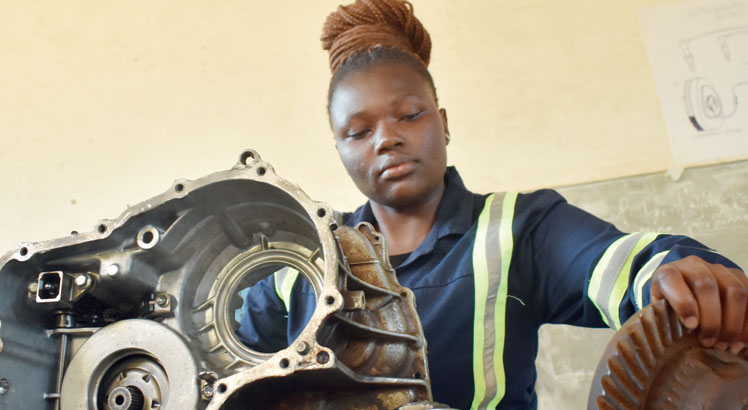
She is among three girls in an automobile mechanics class of 30 at Andiamo Technical College in Balaka Town, the cradle of Alleluia and Zembani bands.
However, Balaka music is not what welcomes visitors to the Catholic institution, run by Andiamo Youth Trust. Rather, a massive bell tolls mildly every 15 minutes, alerting trainees to go to class or for break.
“There is no time to waste,” says Chitedze. “Mum is a housewife and dad is a security guard, so I need these skills to beat poverty.”
The male-dominated class and greasy engines no longer intimidate the girl who dreams of owning a garage.
“Fear disappeared the day I arrived from Bangwe in Blantyre. From the first class by Madam Mwaiwawo Mtimaukanena, I knew I was in the right place to become a mechanic like her,” she says.
Skills for good
Andiamo is one of 32 training institutions under the Skills for a Vibrant Economy (Save) project, financing by the World Bank with matching funding from the Government of Malawi. The technical, entrepreneurial and vocational education and training (Tevet) Authority is implementing the $100 million (K180 billion) initiative in 15 community technical colleges and skills development centres.
Needy girls such as Chitedze receive tuition, upkeep allowances and examination fees. Boys constitute 40 percent of the recipients.
“The support helps me get essential skills in peace, leaving my parents to support my three siblings,” says the third born in a family of four.
Save is constructing a 22-bed hostel at Andiamo to liberate girls from long travels to class and risky sexual encounters in self-boarding settings off campus.
Chitedze states: “Safe accommodation will help more girls acquire vital skills no one can take away. It will protect girls in self-boarding from risky activities that fuel unwanted pregnancies and marriages. “
The Level Three trainee states: “It’s my wish to see every girl attending lessons and evening studies without worrying about the dangers that lurk in darkness as they return to their rented homes.”
According to Principal Luwicho Kalambo, Andiamo Technical College enrols 210 students split into two cohorts.
“We have 40 girls, but only 37 have secured bed space on campus,” he says. “The new hostel will increase girls’ enrolment to 62, guaranteeing them safe accommodation. About 20 girls from the cohort currently on industrial attachments stay off campus.”
Kalambo says Save interventions have reduced dropout rates as scholarship recipients no longer worry about financial uncertainties.
“Up to 15 percent used to drop out by second term due to lack of fees, but that is almost history,” he says.
Village head Chauluka says the girls expected to wave goodbye to sexual exploitation in unregulated self-boarding homes will free up houses for people working and doing business in Balaka.
“I see more girls acquiring rewarding skills to become role models for their peers to get relevant skills,” he says.
The Save project is supporting construction of essential facilities, higher learning for tutors and trainees’ bursaries in 10 public universities, seven national technical colleges and 15 community colleges.
Government and the World Bank has extended the five-year project to June 2027. All construction are expected to be completed by December this year.
‘We want more girls’
Automobile mechanics instructor Lawrence Chilanga expects the hostel taking shape to help eliminate gender disparities in his class.
“We want more female mechanics like Madam Mtimaukanena, who takes the first class to show beginners that girls can do the jobs men monopolise. We want trainees to become reliable citizens regardless of their sex,” he says.
Girls constitute 41 percent of Tevet enrolment, up from 25 percent in 2025 and 40 in 2024.
Chitedze dreams of opening a garage that will train and employ the youth, particularly girls who dream big.
“Where there is a will, there is a way,” she says.